Academic research & policy analysis

Research & PublicationsBernardo Gortaire Morejón

This page brings together my published research, books, and academic articles on international relations, security, oceanopolitics, regional integration, and Latin American affairs. Some works are freely available for download, while others link to external publishers or bookstores.I identify the reading language of each work. Some have an English PDF; others remain available only in their original Spanish because an authorized translation is not available.

English PDF available Available in Spanish only
Books and research on Latin America, geopolitics, and strategic intelligence
Published work

Books

Here I present books I have written, edited, or co-authored and published by university and academic presses. I retain each original Spanish title and provide an English translation in brackets.

The sole-authored books address inequality, democratic dissatisfaction, state weakness, organized crime, and regional integration in América Latina, la región que se niega a ser [Latin America, the Region That Refuses to Be] (2024); the return of war to Europe through a historical and strategic lens in La guerra nunca se fue [The War Never Left: How the Russo-Ukrainian Conflict Revived History] (2024); and contested hegemony, constraints on China's rise, and the autonomy of developing countries in Dragón ascendente, águila desafiante [Rising Dragon, Defiant Eagle: Unraveling Sino-American Hegemonic Competition] (2023). Ecuador hacia el 2025 [Ecuador toward 2025: Scenarios, Conflicts and Opportunities] (2023) presents a collective foresight exercise, while El camino a la integración desde la identidad [The Path to Integration through Identity: A South American Approach] (2020), co-authored with Mauricio Montalvo, examines the identity foundations of integration. The chapter Límites de la inteligencia estratégica en América Latina [Limits of Strategic Intelligence in Latin America] studies intelligence culture, politicization, resources, professionalization, and regional cooperation.

Sole-authored
Free PDF Cover: América Latina, la región que se niega a ser
2024 · Sole-authored

América Latina, la región que se niega a ser

[Latin America, the Region That Refuses to Be]
Universidad de las Fuerzas Armadas-ESPE

This book shows that Latin America lacks neither resources nor possibilities, but rather the political capacity to recognize itself and act as a region. This strategic synthesis connects poverty and inequality with democratic dissatisfaction, state weakness, and transnational organized crime. Faced with problems that already transcend national borders, regional integration emerges as a practical tool for coordinating public policy and building collective responses.

Free PDF Cover: La guerra nunca se fue: Cómo el conflicto ruso-ucraniano revivió la historia
2024 · Sole-authored

La guerra nunca se fue: Cómo el conflicto ruso-ucraniano revivió la historia

[The War Never Left: How the Russo-Ukrainian Conflict Revived History]
Universidad de las Fuerzas Armadas-ESPE

The war between Russia and Ukraine did not begin in 2022. Its roots span centuries of shared history, fractured identities, imperial aspirations, and accumulated geopolitical tensions among Russia, Ukraine, and NATO. This work reconstructs the path that brought war back to Europe and warns of its consequences for international law, multilateralism, and global security.

Free PDF Cover: Dragón ascendente, águila desafiante. Desentrañando la competencia hegemónica entre China y EE.UU.
2023 · Sole-authored

Dragón ascendente, águila desafiante. Desentrañando la competencia hegemónica entre China y EE.UU.

[Rising Dragon, Defiant Eagle. Unraveling the Hegemonic Competition between China and the United States]
Universidad de las Fuerzas Armadas-ESPE

This book explains why China's rise does not automatically entail the fall of the United States. The two powers are engaged in economic, technological, military, and diplomatic hegemonic competition. The work defines the current moment as one of contested hegemony, identifies the structural limits of China's rise, and examines the main risks surrounding Taiwan and the Indo-Pacific, as well as the scope this rivalry creates for developing countries to pursue strategic autonomy.

Edited & co-authored
Free PDF Cover: Ecuador hacia el 2025: escenarios, conflictos y oportunidades
2023 · Editor

Ecuador hacia el 2025: escenarios, conflictos y oportunidades

[Ecuador toward 2025: Scenarios, Conflicts and Opportunities]
With: Guerrero, G.; Lapeña, R.; Fernández, M.; Lozada, P.; Camino, J.F.
Universidad de las Fuerzas Armadas-ESPE

This collective volume combines foresight analysis with contextual readings of the political, institutional, economic, and security scenarios Ecuador was expected to face between 2023 and 2025. Its chapters examine regional geopolitics, institutional weakness, maritime security, parliamentary diplomacy, and non-state actors. The volume reframes security and defense as matters of public policy and promotes strategic thinking grounded in Ecuador's particular circumstances.

Publisher Cover: El camino a la integración desde la identidad. Una aproximación suramericana
2020 · Co-authored

El camino a la integración desde la identidad. Una aproximación suramericana

[The Path to Integration through Identity: A South American Approach]
With: Montalvo, M.
UDLA Ediciones

Regional integration begins before treaties: it begins when different societies recognize themselves as part of a shared project. This work develops the theory of identity-based integration and explains how cultural, political, and historical foundations create commitment, align interests, and sustain cooperation. UNASUR's trajectory shows what happens when affinity among governments substitutes for the institutional and social work of building a South American identity: integration fails despite the region's need for it.

Book chapters
Publisher Cover: Límites de la inteligencia estratégica en América Latina
2023 · Book chapter

Límites de la inteligencia estratégica en América Latina

[Limits of Strategic Intelligence in Latin America]
Marcial Pons — Madrid, Spain

The principal weakness of Latin American strategic intelligence lies not only in technology, but in its subordination to the governments of the day. The study draws on an exploratory questionnaire administered to intelligence specialists in Latin America. It reveals the problems of intelligence culture, politicization, resources, staffing, political will, and corruption that affect Latin American intelligence agencies. The chapter proposes turning intelligence into a permanent state capability through professionalization, regional cooperation, and greater civilian participation.

Academic research

Academic Articles

Here I gather my peer-reviewed and other academic articles in political science, international relations, security studies, and regional studies. In each record, I identify its verified editorial status.

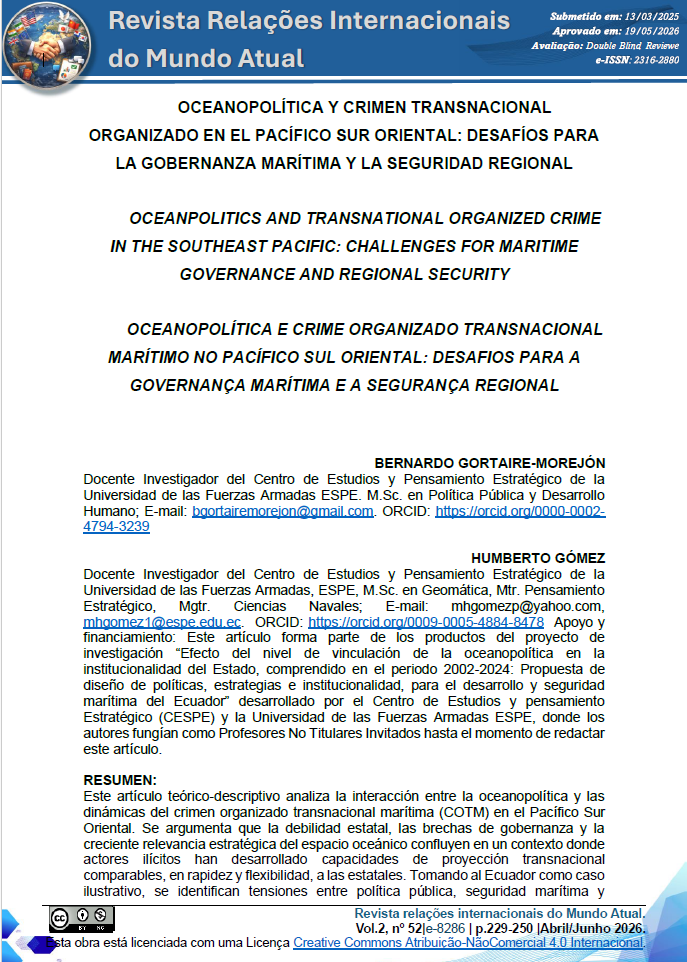
First page: Oceanopolítica y crimen transnacional organizado en el Pacífico Sur Oriental: Desafíos para la gobernanza marítima y la seguridad regional

Oceanopolítica y crimen transnacional organizado en el Pacífico Sur Oriental: Desafíos para la gobernanza marítima y la seguridad regional

[Oceanopolitics and Organized Transnational Crime in the Southeastern Pacific: Challenges for Maritime Governance and Regional Security]

The ocean is not an empty space between states, but a territory where criminal power is also projected. This article introduces the concept of 'parallel oceanopolitics' to explain how illicit networks exploit governance gaps and jurisdictional fragmentation in the Southeastern Pacific. Ecuador serves as a case for proposing a state maritime policy based on intelligence, interoperability, port control, and regional cooperation.

DOI: 10.21902/Revrima.v2i52.8286
View publication page Read / Download English PDF View in journal
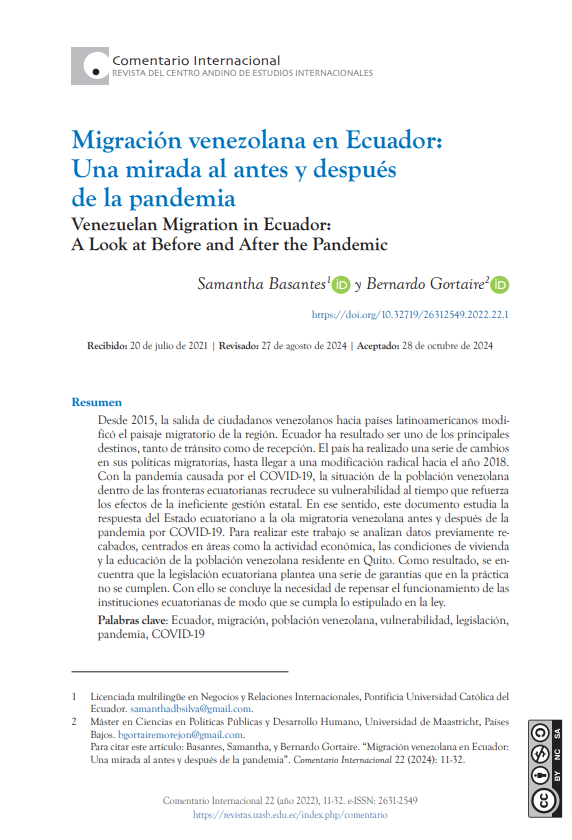
First page: Migración venezolana en Ecuador: Una mirada al antes y después de la pandemia

Migración venezolana en Ecuador: Una mirada al antes y después de la pandemia

[Venezuelan Migration in Ecuador: Before and After the Pandemic]

Ecuador constitutionally recognizes universal citizenship, but Venezuelan migration reveals the distance between that principle and its application. Drawing on exploratory data from vulnerable people who sought assistance in Quito during the pandemic, this article traces the securitizing turn in migration policy, xenophobia, and barriers to employment, housing, and basic services that deepened in Ecuador from 2020 onwards.

DOI: 10.32719/26312549.2022.22.1
View publication page Read / Download English PDF View in journal
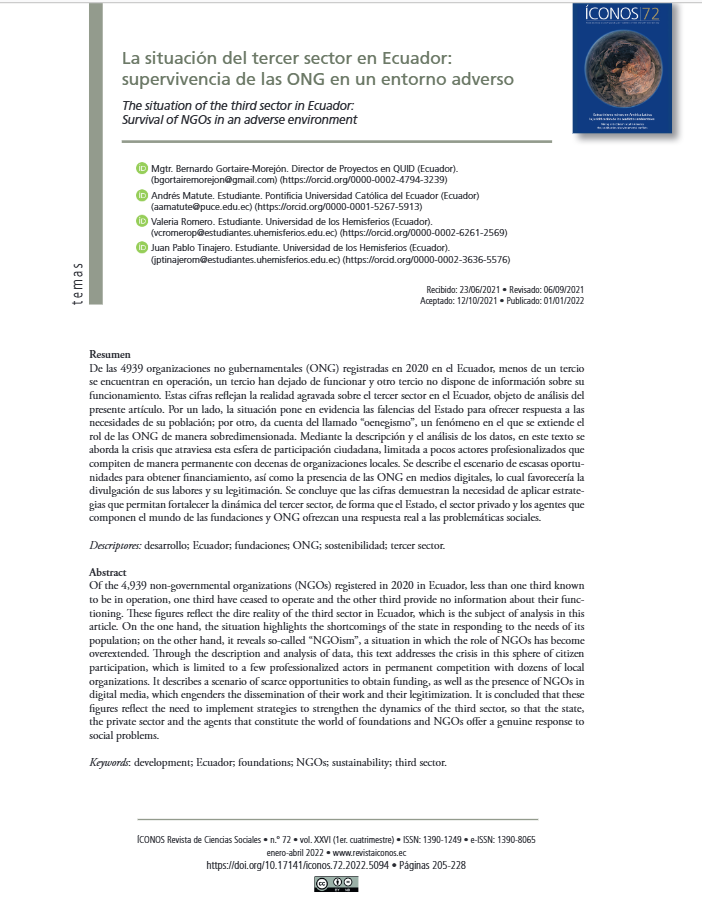
First page: La situación del tercer sector en Ecuador: supervivencia de las ONG en un entorno adverso

La situación del tercer sector en Ecuador: supervivencia de las ONG en un entorno adverso

[The State of the Third Sector in Ecuador: NGO Survival in an Adverse Environment]

This article reveals that of the 4,939 NGOs registered in Ecuador in 2020, only 31.38% were active—an alarming figure. Behind these numbers lies a third sector marked by Ngoization, scarce funding, geographic concentration, uneven professionalization, and limited digital visibility. The article proposes a roadmap toward sustainable, transparent organizations that are better connected to the social fabric.

DOI: 10.17141/iconos.72.2022.5094
View publication page Read / Download Spanish PDF View in journal
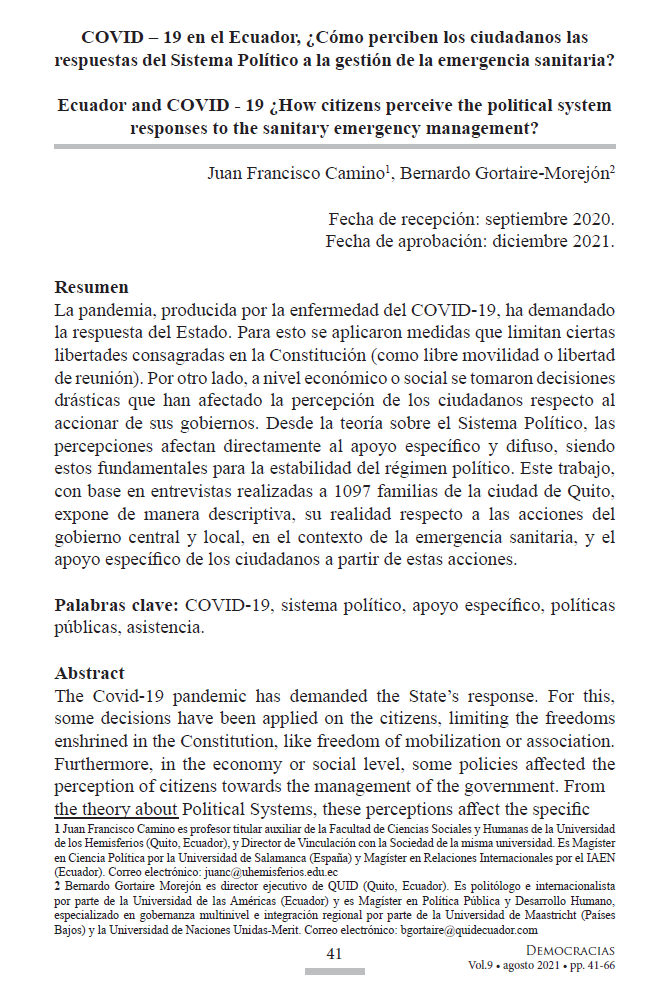
First page: Covid-19 en el Ecuador, ¿Cómo perciben los ciudadanos las respuestas del Sistema Político a la gestión de la emergencia sanitaria?

Covid-19 en el Ecuador, ¿Cómo perciben los ciudadanos las respuestas del Sistema Político a la gestión de la emergencia sanitaria?

[COVID-19 in Ecuador: How Citizens Perceive the Political System's Response to the Health Emergency]

During the first COVID-19 restrictions, many vulnerable families had to turn to non-state actors for the assistance they needed to survive. The experience of 1,097 households in Quito that sought assistance helps explain how hunger, unemployment, and institutional neglect affect specific and diffuse political support in Ecuador. This article identifies failures in managing the public health emergency as one factor behind the decline in Ecuador's democratic legitimacy.

DOI: 10.54887/27376192.65
View publication page Read / Download English PDF View in journal
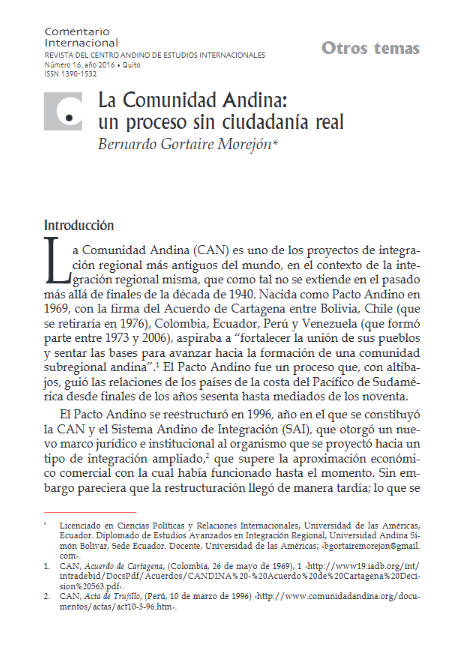
First page: La Comunidad Andina: un proceso sin ciudadanía real

La Comunidad Andina: un proceso sin ciudadanía real

[The Andean Community: A Process Without Real Citizenship]

The Andean Community built institutions, norms, and agreements, but failed to develop citizens who recognized themselves as part of a shared project. Its social agenda arrived late, and civil society remained distant from regional decision-making. This article explains how the absence of effective community citizenship allowed national interests to prevail and turned Andean integration into an institutional process with limited social legitimacy.

DOI: 10.32719/26312549.2016.16.4
View publication page Read / Download English PDF View in journal
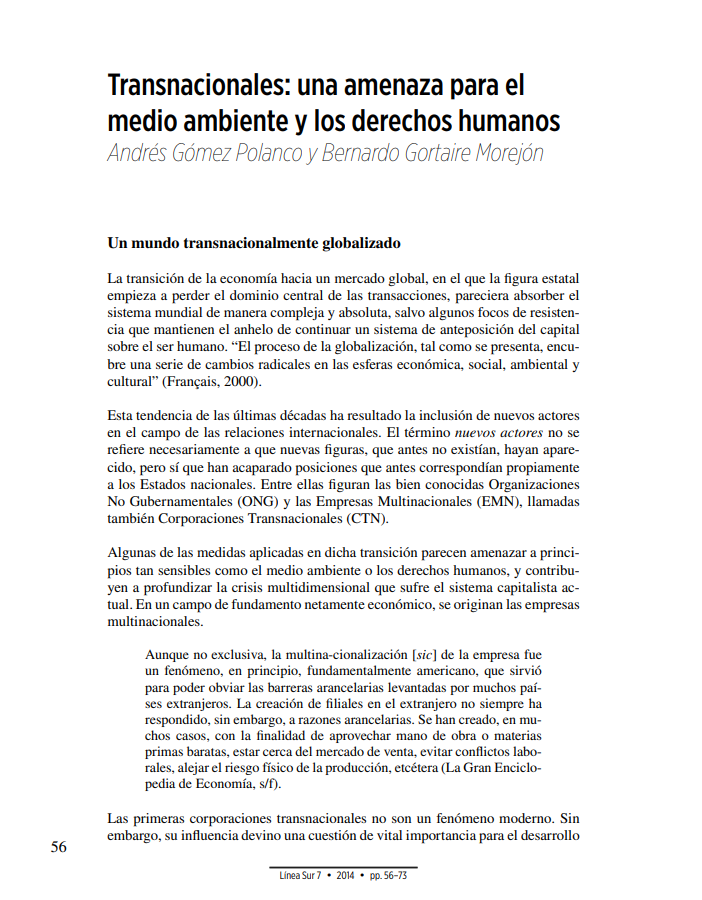
First page: Transnacionales: una amenaza para el medio ambiente y los derechos humanos

Transnacionales: una amenaza para el medio ambiente y los derechos humanos

[Transnational Corporations: A Threat to the Environment and Human Rights]

This article describes how transnational corporations can accumulate more bargaining power than the states responsible for regulating them. Disputes over water privatization in Bolivia and Chevron–Texaco pollution in Ecuador serve as case studies of the environmental and human consequences of this imbalance. Given the inadequacy of voluntary corporate social responsibility, the article proposes enforceable legal obligations and regional integration capable of acting as a regulatory counterweight.

View publication page Read / Download Spanish PDF View in journal
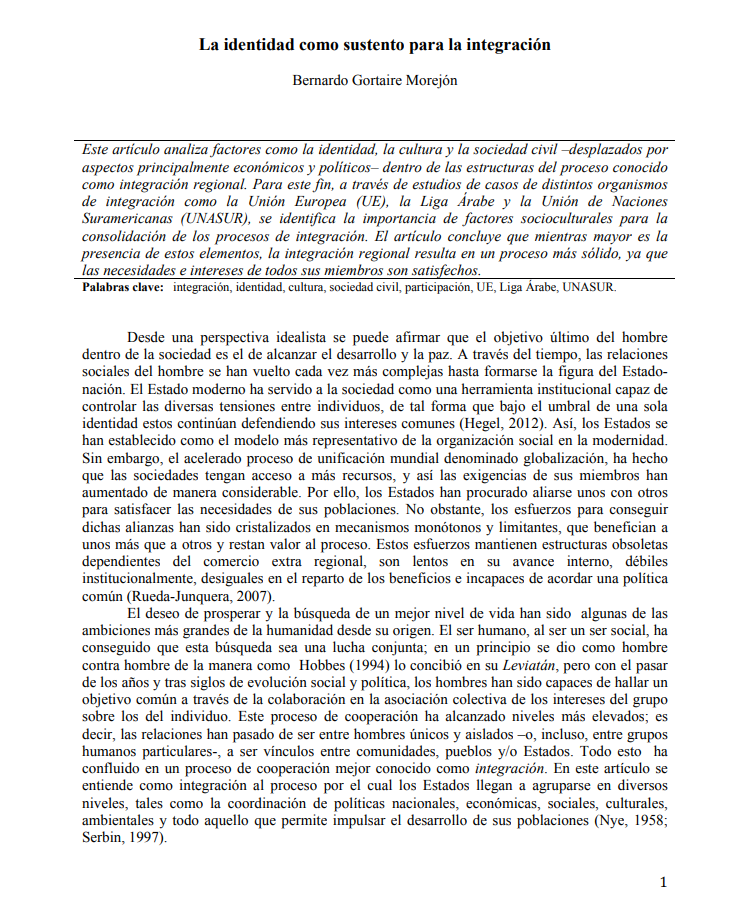
First page: La identidad como sustento para la integración

La identidad como sustento para la integración

[Identity as a Foundation for Integration]

This article marks the beginning of my research program on regional integration. This first exploratory study concludes that trade agreements are not enough to unite societies that do not recognize themselves as part of the same project. Drawing on constructivism and the cases of the European Union, the Arab League, and UNASUR, the work shows how collective identity and citizen participation can strengthen or weaken regional integration. The study lays the foundations for the later theory of identity-based integration.

View publication page View in journal
Working papers & reports

Other Research

Here I share my policy briefs, working papers, magazine articles, institutional reports, and applied research published outside academic journals.

Magazine article 2026

The Great Challenge of Ensuring Hemispheric Security Without Repeating the Mistakes of the Past

In this article, published in Issue 4 of Security and Defense Monitor (September 2026), I argue that hemispheric security cannot be guaranteed through militarization or authoritarian control. I connect inequality, weak state capacity, illicit markets, arms flows, and drug demand to show why security policy must address structural causes while preserving the rule of law and human rights. I propose a comprehensive and accountable approach that combines regional cooperation, financial intelligence, drug-demand reduction, institutional strengthening, and democratic oversight.

Working paper 2022

The Erosion of Multilateralism and the Reconfiguration of the International Security Landscape

This strategic report explores why liberal multilateralism remains necessary even though its current structure no longer responds adequately to the challenges it must address. The pandemic and the Russo-Ukrainian war exposed the flaws of veto power in the United Nations Security Council, double standards, inequality in decision-making, and the gap between institutional effectiveness and legitimacy. The analysis considers possible reform scenarios based on regional integration, South–South cooperation, technological democratization, and United Nations reform. Prepared as part of my work with CESPE-ESPE.

Working paper · Part I 2022

The Decline of U.S. Hegemony and the Strategic Challenge from China and Other Emerging Actors — Part I

Behind the familiar claim of U.S. decline lies a more complex reality. China has become the United States' principal competitor, but it still faces demographic, industrial, and strategic constraints. This first part examines the redistribution of global power after the Cold War through the historical trajectories, populations, and economic and commercial capabilities of the two powers. Prepared as part of my work with CESPE-ESPE.

Working paper · Part II 2022

The Decline of U.S. Hegemony and the Strategic Challenge from China and Other Emerging Actors — Part II

China can compete with the United States, but it cannot yet replace it as the hegemonic power. This second part extends the comparison to the geopolitical and military dimensions: Taiwan, the Indo-Pacific, alliances, soft power, and power-projection capabilities. The result is a scenario of contained conflict that remains vulnerable to escalation and could draw in countries with no direct stake in the dispute. Prepared as part of my work with CESPE-ESPE.

Working paper · Part II 2022

The Role of Non-State Actors in Regional Security: Social Movements, Organized Crime, and Armed Groups — Part II

This strategic report explains why not every violent actor poses the same threat or warrants the same response from the state. It distinguishes ordinary crime, transnational organized crime, and armed groups by their objectives, structures, forms of territorial control, and international reach. As an alternative to the appeal of 'iron-fist' policies, it proposes combining the state's legitimate coercive authority with education, employment, health care, justice, and the restoration of state capacity. Prepared as part of my work with CESPE-ESPE.

Working paper 2024

The Impact of 2023 on the International Landscape and the Outlook for 2024

The year 2023 produced more than a succession of crises: it revealed the interdependence of geopolitical, economic, social, technological, and environmental risks. This strategic report organizes those signals to explore their possible effects on international relations in 2024. A subsequent evaluation found that the report achieved approximately 82% foresight accuracy. Prepared as part of my work with CESPE-ESPE.

Working paper 2025

Analysis of Transnational Organized Crime Dynamics in the Pacific Maritime Domain

Maritime criminal networks do not recognize the borders that constrain state responses. From mangrove channels to transnational routes across the Pacific, organized crime has established a lasting maritime presence and become a persistent threat to the state. This strategic report explains how institutional weakness on land extends across the ocean. In response to the vulnerabilities of coastal states, it proposes liquid sovereignty, preventive intelligence, port traceability, multinational teams, and social policies to reduce criminal recruitment. Prepared as part of my work with CESPE-ESPE.

Collaborations & inquiries

If you would like to collaborate, request access to restricted research, or discuss any topic covered here, write to me.

Back to home